
November 23, 2026
It's Not a Bug It's an Undocumented Feature: The Developer's Oldest Alibi
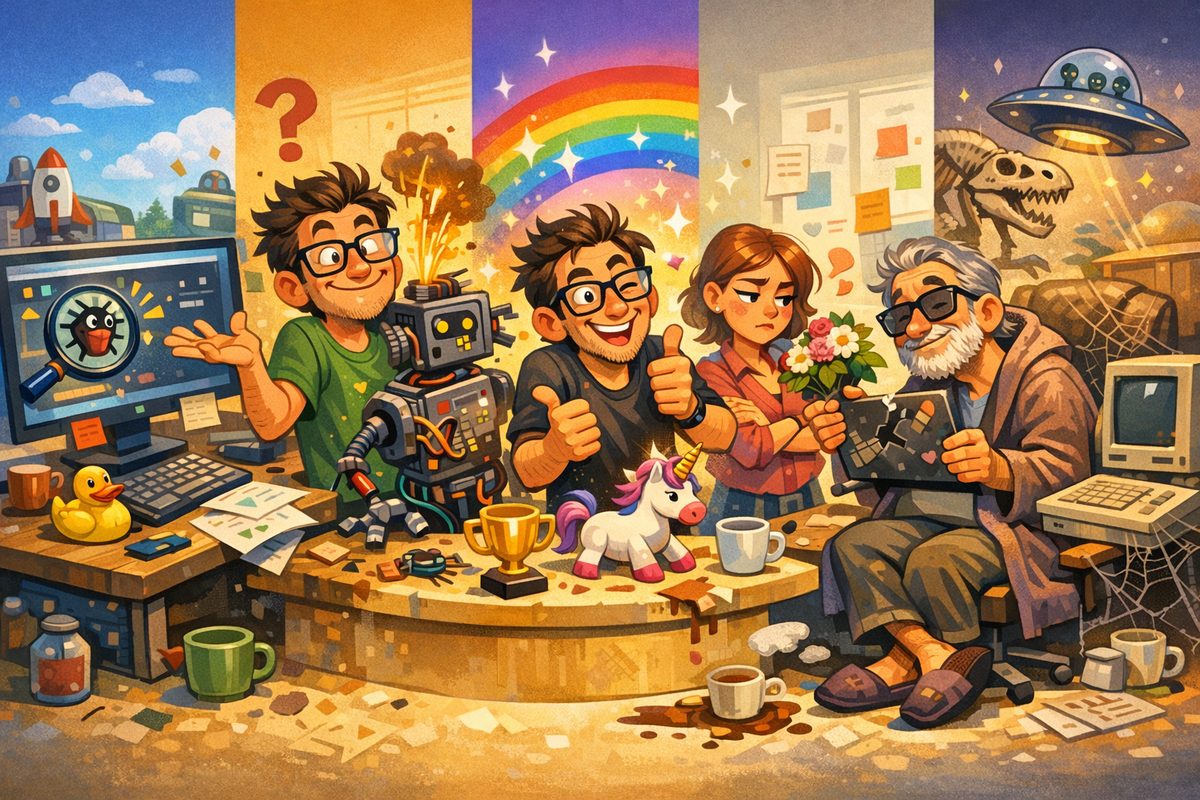
Somewhere right now, a developer is staring at a button that deletes the wrong thing, and a colleague is leaning over their shoulder to say the sentence. You know the one. The button is not broken. The button is demonstrating behavior that nobody planned, nobody wrote down, and nobody is going to be able to take back, and under the rules of the profession that makes it a feature. Welcome to the oldest alibi in software.
It's not a bug it's an undocumented feature, and the legal theory behind it
The logic is airtight in the way that only a joke can be. A bug is something the software does that it was not supposed to do. A feature is something the software does on purpose. The difference is intent, intent lives in documentation, and if nothing was ever written down, then nobody can prove the software was not supposed to do it. The defendant has simply not been charged. The sentence works by moving the argument from "is it wrong" to "did anyone say it was wrong," which is a far better argument to be having when you are the one who shipped it.
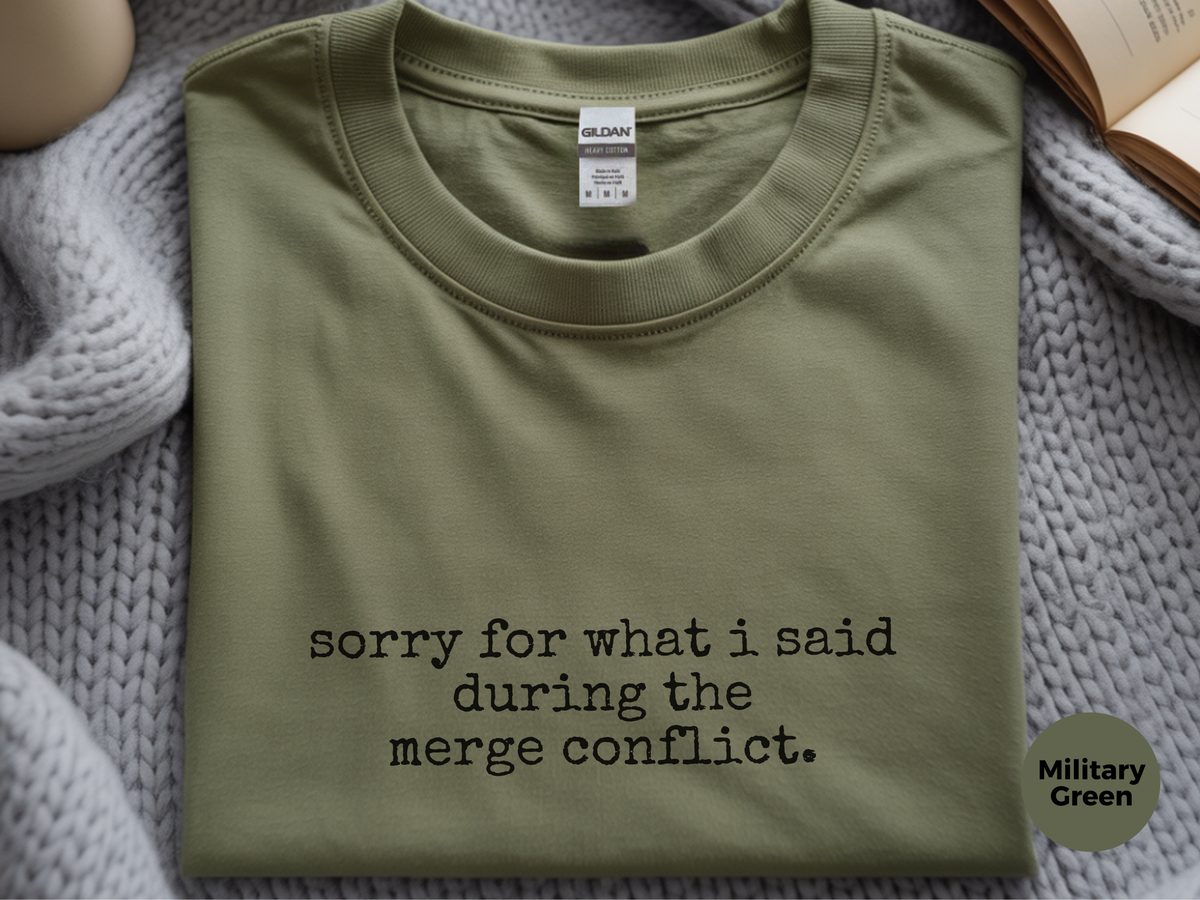 The alibi always has a second act, set in plain lowercase typewriter type with a period at the end: Sorry For What I Said During The Merge Conflict, the closest thing the profession has to a formal apology.
A merge conflict is what happens when two people quietly change the same thing in two different directions, and the software refuses to pick a side until a human does. It is the moment one undocumented feature meets another, and the conversation that follows is rarely one either person would want read back in a meeting. The shirt does not say what was said. It does not need to. Anyone who has resolved one at six in the evening can fill in the blank.
The lowercase is the right call. Capital letters would make it a press release. Lowercase with a period makes it a mumble across the desk the next morning, coffee in hand, which is exactly how this apology gets delivered in real life. It is also a developer shirt a non-developer can read as a peace offering, which makes it a good gift for anyone who shares a codebase, a kitchen, or a group chat.
The five stages of the alibi
The sentence is never used once. It tends to travel through a project in a predictable order:
- The denial. "That is not a bug." Said before anyone has finished describing the problem. A reflex, like a knee jerking.
- The reframe. "It is more of an undocumented feature." The sentence arrives, fully formed, and everyone in the room has heard it before.
- The workaround. "Just do not click it twice." A feature that comes with an unwritten rule is the most honest kind.
- The dependency. Some other team has quietly built something on top of the behavior. It can no longer be fixed, because fixing it would be a breaking change to a thing that was never supposed to exist.
- The documentation. Months later, a tired person writes the behavior down. It is officially a feature now. Nobody remembers it was ever anything else.
That fourth stage is the one that keeps people up at night, and it is the real reason the joke has lasted. Every long-lived piece of software is partly held together by accidents that other people started to rely on. The alibi is not a lie, exactly. It is just the first draft of a truth that takes about two years to arrive.
Where every alibi ends up
 Give the alibi enough years and it becomes Running On Legacy Software, with the words in big gold and charcoal letters over a long-haired rocker in a leather jacket, walking off with a vintage microphone stand over his shoulder like he has somewhere to be.
Legacy software is the fourth stage with a few decades on it. Nobody remembers who wrote it, nobody is allowed to touch it, and the whole building depends on it anyway. It still works, mostly, for reasons nobody ever wrote down, which makes it the most successful undocumented feature in history. The shirt turns that into a compliment. The person wearing it is not out of date. They are load-bearing.
This is the developer's alibi carried all the way to the end. A quirk appears, nobody calls it a defect, other people build on top of it, and twenty years later it is a classic. It works for code, it works for classic rock, and it works, more often than anyone involved would like to admit, for the people who have been around long enough to remember the original bug.
If you want to see how far the idea stretches, the rest of the tech corner is in the full catalog, and our look at why some jokes work on a shirt explains why a sentence this short survives on cotton at all.
Ship it anyway
If there is a developer in your life, you already know which one they are. Either they say the sentence, or they are the one who has to listen to it. Sooner or later, both of them owe the other an apology. Pick the shirt that matches their department, add it to the cart, and let them find out the behavior is intentional.
Never miss a post
New posts, new designs, and subscriber-only offers from Tickle Stitch. No spam, unsubscribe anytime.